There is a conversation unfolding on my social media debating whether “Pride” related topics belong in schools, specifically elementary schools. Specifically local, rural elementary schools. I have too much to say on this to try to engage with a pithy smart ass remark. So I’ll collect my thoughts here for whoever chooses to read them.
Teaching about the world is the job of schools. Teaching students to navigate in the world, to develop skills, values, perspectives that will help them navigate the world. Helping students navigate their inner world is also important and many young people don’t get nearly enough support in that regard.
Teaching about the world is also a job for parents and extended family and other community supports, spiritual communities, youth organizations and so on. Helping young people navigate their inner world is also important and, I repeat, many don’t get nearly enough support in that regard. In particular, some kids don’t get to feel safe or loved at home for who they really are.
I know some of this because I grew up in a rural farming community, surrounded by church-going folk. I attended a tiny elementary school and you can bet that in the 1970’s there was no talk of any “alternate lifestyles”. There was one way to be and by God that was what you were going to be, come Hell or high water or getting the sense beat out of you. Literally.
I consider myself lucky in so many regards to have been raised where and when I was. But I will say this. I was raised to be thoroughly dishonest with myself. I was raised to be filled with self-hatred. Because every signal, every nuance, every raised eyebrow, every derogatory remark about gay people was about me. Everyone around me hated gay people, mocked them. And I knew from a young age I was gay. So … self-hatred or exile. These were my choices.
I probably realized in my mid-teens that I was queer and I was horrified. Imagine – being horrified at something that is an essential, non-negotiable part of your being. Like being ashamed of having green eyes or brown hair or being left-handed. It just … is.
I didn’t want to lose my family so I chose to fill my inner world with self-hatred. Because being honest was far, far too frightening.
I’m trying to imagine what it would have been like had I been born more recently and attended schools where the concept of many possible life paths had been at least presented without mockery or judgement. Just … as another part of the world. Here is the world. As you navigate through it, you’ll meet queer people. Some are lovely. Some are less so – just like, oh, everyone else. Just … people.
If someone, somewhere had said something nice about gay people when I was a child, I would have had a bit of hope, a glimmer of some kind of light in the dim self-hatred that I clung to. But that wasn’t the time for such perspectives. I’m grateful that my suicide attempt at age 17 was half-hearted and easily thwarted. But it does form part of my story.
Many rural kids leave their rural origins for lots of reasons – more opportunities, post-secondary education, turning boredom into adventure. Queer kids leave their home communities when it feels safer to go than it does to stay. They leave so they can find their people. Often, that means the nearest big city. Once they have found their “tribe”, their chosen families, the people that accurately reflect back to them who they feel they really are, in honesty … coming home to the family of origin is very difficult. There is familiarity and yet there is a strange invisibility. The people that should know you best really do not. Nor, in many cases, do they wish to. Queer adults often feel like strangers amongst the people they have known and loved the longest.
So I’ve had to find my way through both the self-hatred and the exile, as it turns out. I wouldn’t wish that journey on anyone’s child and yet, again, I’m grateful. The people I’ve met, really good people. The communities and connections I’ve built. The inner strength and fortitude to handle just about anything – not an invitation, universe, back off baby – the patience I’ve had to develop to deal with truly ignorant people. These are some of the gifts of my journey.
Think of Pride in schools as a suicide prevention strategy. Here are some statistics, courtesy the Trevor Project:
Suicide is the second leading cause of death among young people aged 10 to 24 (Hedegaard, Curtin, & Warner, 2018) — and lesbian, gay, bisexual, transgender, queer, and questioning (LGBTQ) youth are at significantly increased risk.
LGBTQ youth are more than four times as likely to attempt suicide than their peers (Johns et al., 2019; Johns et al., 2020).
The Trevor Project estimates that more than 1.8 million LGBTQ youth (13-24) seriously consider suicide each year in the U.S. — and at least one attempts suicide every 45 seconds.
The Trevor Project’s 2022 National Survey on LGBTQ Youth Mental Health found that 45% of LGBTQ youth seriously considered attempting suicide in the past year, including more than half of transgender and nonbinary youth.
Removing “Pride” from schools, or children from “Pride” topics will not result in fewer queer or trans kids. It will result in children being terrified to talk to their parents and families about who they really are. “If my Mom doesn’t like Pride, I must be bad.” You won’t know that is even happening for your children until they get brave enough to tell you, probably in anger or terror, when they are adults. If they survive.
By being afraid of, or angry about, “Pride” being taught in schools, parents condemn their own children to self-hatred, possibly self-harm, and a painful choice in the future to leave to find safety elsewhere. For those kids who are not queer, you are training them to be “ok” with hating people. Just people. No better, no worse than anyone else.
Me: OK … well, about a year ago, we started planning renovations with Mike and Lisa, so that is good.
Sally: Sure – they are nice.
Me: Yes.
Sophie: … messy, disruptive, noisy …
Me: They put in your heated floor in the new bathroom.
Sophie: Oh, I love them.
Me: Specifically, Mike did that. Thank him when he comes back on Friday.
Sophie: I will refrain from leaving a hairball in his shoes.
Me: That will do. I had SO MUCH FUN designing the spaces with Lisa. I didn’t realize how much fun that would be.
Sally: …
Sophie: …
Me: Anyway, we’ve been in a global pandemic since March 2020 … that has been stressful. Two years now.
Sally: Is that why humans come into the house wearing muzzles?
Me: Those are masks, not muzzles. But yes. So, a year ago, people thought maybe the pandemic might be over. And we had a pretty ok summer, pandemic-wise.
Sally: …
Sophie: …
Me: In July, Big Dee collapsed on the deck in front of me. Turns out he was really sick.
Sally: I knew he was sick for a while.
Me: Yes, I think you did. … We lost him later in July. It was awful.
Sally: I miss Big Dee.
Sophie: To my surprise, I miss him too.
Me: I miss him so much. I still can’t believe he isn’t here.
Me: I sold my pink Barbie boat and bought a refurbished non-Barbie boat.
Sally: YES! That was awesome.
Me: It is pretty awesome. I named it after Big Dee.
Sophie: You never name anything after me.
Me: Nothing as beautiful as you has happened yet.
Sophie: Oh. Yes, that makes sense.
Me: Moving on … there was some family stuff in the fall – do you remember that?
Sally: When you were out on the deck in the rain trying to get a cell signal? A bunch of times?
Me: Yes, that was it. On the “up” side, we got a quick visit from Angela around birthday time, so that was a treat.
Sally: She is nice.
Sophie: She likes me a lot.
Me: Yes, she does. … later on in the fall, we moved upstairs so the kitchen reno could start … that was … interesting …
Sally: Yes! I remember that!
Sophie: I remember being under a bed for six weeks.
Me: Yes, I’m so sorry about that.
Sophie: There was a huge dog upstairs with big teeth.
Me: Yes. I’m so sorry.
Sally: What happened to Mr. Handsome?
Me: He is living his best life on a farm. He didn’t really fit in here as well as we’d hoped.
Sally: … I guess not … but being the only dog doesn’t really suit me.
Me: I know, sweetheart.
Sophie: Suits me.
Me: I know … and we will return to this subject … moving on … we moved back downstairs in December … and I started to enjoy my new kitchen …
Sally: I like it. It is bigger. There are more high traffic areas for me to sprawl out on while you are cooking.
Me: Yes, I noticed.
Sophie: I like the heated floor.
Me: That is in the bathroom.
Sophie: Best room in the house.
Me: I’m glad you like it … moving on … So, I had planned a big Christmas trip for December after the grades were in. Sally, we were supposed to go on two big Ontario road trips, first to see family in Thornbury, and our friends in K/W including crazy dog RayLynn, then a big dinner with friends in St. Catharines, including your little friend Bella, and then to Strathroy for more family … and maybe a stop in Drumbo … it was going to be great.
Sally: Did we do that trip?
Me: Nope. The pandemic returned with something called Omicron.
Sally: Darn. That sounded like a fun trip.
Me: Friends were going to visit after Christmas and then we were going to do road trip part two to Ottawa for New Years … none of it happened because … Omicron.
Sally: I don’t like pandemic stuff.
Me: Me either … I haven’t seen “my people” for literally months … moving on … my job is a bit weird right now. We are employing “work to rule” strategies to motivate management to negotiate. That started in December. It keeps escalating … Stressful.
Sally: …
Sophie: …
Me: The renos aren’t quite finished yet, for 1,000 reasons, and we are living in a partial construction zone. Nothing is stored in its rightful place yet and it is starting to feel quite claustrophobic. To me anyway.
Sally: I hadn’t noticed.
Sophie: Me either other than its a bit of an obstacle course around here.
Me: I know. It is discombobulating.
Sally: Big important word.
Me: Big word, not that important really.
Sally: OK.
Me: There is a war happening that is pretty awful. There is almost always a war happening somewhere. This one is just as horrible, unfair, and shocking as most wars are.
Sally: Is that like a dog fight in the park?
Me: … mmm … yes, sure. But with more dogs than you can count and the fights end in death and destruction.
Sally: OH! that sounds awful and confusing and unnecessary. My “fights” only last about ten heartbeats and I’m just trying to show that I’m strong. No one gets actually hurt.
Me: I know … War is a terrible, stupid choice for resolving differences and many humans are sad and stressed about it.
Sally: I know you are stressed.
Me: Yeah … everything is starting to get more expensive and that is also stressful.
Sophie: Can you still pay the hydro bill for the heated floor?
Me: Yes, so far that is ok.
Sophie: Phew.
Me: So, it has been a long, dark, lonely winter. And as Uncle Gin said the other day, no one is really doing well right now, mental health wise.
Sally: Are you ok?
Me: I’m “ok” but I’m really tired of waves of bad news. And I’m stuck in my personal routine which involves a lot of sitting at the computer. So I could be better. I feel we need … I need … some new energy in the house. It will be spring soon and I don’t want to feel so weighed down. And, Sally, I think you need a friend.
Sophie: … I don’t think I like where this is going …
Sally: This sounds awesome so far … go on …
Me: So … I think we need … A PUPPY!!!
Sally: Yay … wait, what? What is a puppy?
Sophie: You’ve GOT to be kidding.
Me: Sally, a puppy is a baby doggie that will grow up to be your friend. It’s going to be great. You both have a job to do. You can help me train him! Sophie, you can teach him how to respect cats.
Sophie: … (looks for lawyer’s email address) …
Me: Hang on Sophie, remember how you and Big Dee made friends eventually? This will be even easier than that. We are starting from a blank slate. This puppy has never even met a cat yet.
Sophie: … (dubious) …
Me: You’ll see.
Sally: When the puppy arrives, will you still love me?
Me: Oh, sweetheart – always. You are so patient with me. You’ll need to be patient while we train him. I think you are going to love having a little brother and I’m going to love watching you teach him.
Me and Sally, July 30, 2021
Sally: Okay! Let’s do this!
Sophie: (closes eyes) … Jesus, Mary and Joseph … Can we block off the bathroom with the heated floor so I can get in and he can’t?
Me: No … BUT … you will always be the only pet allowed on the bed with me.
Sophie: … (still dubious) ok … bring it on …
Me: If the weather holds, I’ll be bringing him home tomorrow. Buckle up!
I am about eight years old and in need, in my mind, of an after school snack. My favourite, which I can manage on my own, is melted cheddar cheese on white bread. I just slice cheese, put it on bread, and pop it in the toaster oven. No sweat.
I have to manage on my own. There are a total of 12 people in this huge house. Mom is busy.
I’ve been thinking of this cheese snack for a while on the bus. Eagerly, I go the fridge and look at the place where cheese is kept. There is a sliver of cheddar, about two bites of cheese. No where near enough, in my mind, to manufacture my snack. Tomorrow is grocery day so this is it. I hold in my small hand the full inventory of cheese in the house.
I … lose it. This doesn’t happen often but on this particular day, I lose it. What does this look like? I’m not sure but I think I’m pretty loud. There are tears. Clearly, I’m old enough to not hurt myself with a knife or a hot toaster oven, but not old enough to get it together in the face of nutritional disappointment.
Mom appears, bustling. I’m standing with the fridge door open, holding this pathetic excuse for cheese, wailing.
Assessing the situation, Mom takes me over to the kitchen table. No anger, some reassurance, no hugs or cuddles. This is a teaching moment.
She sits at the table with two bread slices in front of her, I kneel on a chair seat, elbows on the table, to watch. I’m completely skeptical that anything good can come of this, but I’ve stopped crying.
Wordlessly, with precision and patience, Mom slices the cheese in matchstick-like slivers, producing more slivers than I would have thought possible. Then she arranges them on the bread in such a way that most of the bread real estate is covered, or it will be when the cheese melts. Moments later, I have perfect cheese toast in front of me.
I’m stunned and a bit ashamed to have made a fuss. I’m only eight but the impact of what just happened resonates deeply.
True, sometimes there is no “cheese” at all and moving forward, finding success or contentment, is hard. Disappointment is hard.
Mom taught me to step beyond the disappointment and ask a different question: What have we got to hand and what can we do with it? So often, in my life, creating a work-around has led me to a better place than my original plan would have.
I’m so grateful she was the person she was. No nonsense, pragmatic, fun. Missing her always.
I was having such a lovely weekend. Truly. Granted it was the first time in ages that I’d been around that many white people for several days in a row. Sure, it was heteronormative, as far as I could tell, but at least “not hostile” to queer folk. Well-meaning and good-hearted, as far as I could tell.
You were a real gem. Kind, vulnerable. Funny, willing to put yourself out there and be teased. Respectful, as far as I could tell.
Then, in the final few hours of the event, you had to go and make that racist joke, for no reason, out of the blue.
I felt my heart stop and my face freeze. Really … did I just hear that?
I did. You didn’t get the reaction you were looking for from the people around you and you went further. I took some comfort that I wasn’t the only one who didn’t laugh and conversation picked up elsewhere.
There is a moment in Marilyn French’s book, The Women’s Room, in which Mira’s “perfect” male partner, Ben, simply assumes that Mira will drop her career and the rest of her life because he has been asked to move to Africa as part of a job advancement. After months of “seeing” Mira as a whole person, his male privilege – so ingrained – simply erases her as an individual and she becomes his appendage. With one sentence.
You “Ben’d” me. You bend me. You bent me.
Heaven knows, I’m not perfect. I’m not proud of the amount of white-classist-racist-privileged-gendered-homophobic crap that has come out of my mouth over the years. I’m trying to pay attention and I know I’ve done a lot of work. But you … you had no idea what had gone wrong in our budding friendship.
I failed in my personal mission of calling people directly on their crap. In that moment, I didn’t want to be the strident judgey person who polices everyone’s remarks. It was such a nice weekend, after all. Strident is a word we only use for women, so I should say I didn’t want to be that strident bitch who polices conversation. So I police myself. I withdrew and stopped investing in connecting with you. I made a choice to not ruin the overwhelmingly positive energy of the weekend. For you and for others, that is. Your remark had already slapped a barnacle on it for me. I spent the next several hours trying to picture how to draw you aside and explain what had happened without making the weekend’s good vibes completely dissipate. I’m supposedly good at communicating but I couldn’t figure this one out. And it is still bothering me.
I’m glad you had a great, amazing weekend with no barnacles. I had a really good weekend with some really amazing parts and a serious barnacle that won’t let go.
Yesterday, Christmas Eve, would have been my Mom’s 93rd birthday. As with most Christmas Eves, I spent it with her in mind. I have created a new tradition in which I float a candle down the river on a paper boat on Christmas Eve, in her honour. However, this year, there is 18 inches of thick wet slippery snow on the docks, plus a few layers of ice, and I suspect that Mom would understand me not wanting to join her in the Great Beyond just yet. So I skipped that part.
Instead, I baked. Peanut butter chocolate chip cookies, date squares and orange coconut chews. I love it when my kitchen smells like my Mom’s kitchen.
One of the bits of math I do from time to time is to consider my current age (53) against what my Mom would have been doing at the same age. When my Mom was 53, I was 13. Yikes. I can’t imagine having a 13 year old, two adult sons, and a full household to run. I don’t know how she did it. Â My life is pretty sloth-like compared to hers.
I miss her every day. Her funny wisdom, practicality, and child-like wonder at all the new things the world was churning out.  The endless cribbage games and cups of tea and coffee. I hope she has found some decent euchre players in heaven.
Usually, when moving to a new place, there is the excitement of setting up one’s living space as suits. Unpacking, finding new homes for treasured things. The wonderful feeling of getting settled.
That didn’t happen in the move up here, October 2011. The whole thing was rushed, complex, fraught with last minute disasters. The first morning, I recall, was really sweet as we had friends helping and I made a huge breakfast and, for a little while, I managed to get my hands on that feeling of adventure and fun, setting up a new home with my partner and kids.
I never really nested, though. That settledness didn’t ever happen properly. Things were never in their right places. Everything felt off, like a chair you really want to sink into, that looks so comfortable, but it just won’t let you.
Rooms kept getting re-arranged. Boxes became like furniture – still packed – and just sitting there.
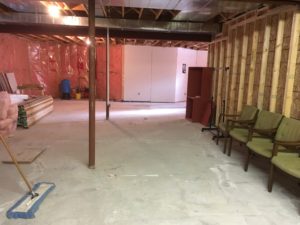
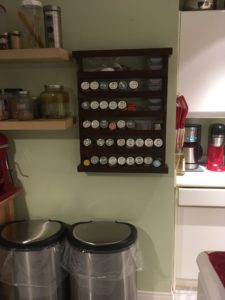
Much of the last year then, the fun of it, has been the nesting. Every week, sometimes every day, sees some new minor improvement that advances the settling cog one or two notches further. Â Today I had a couple of nice local teens, looking for Christmas money, help me for a couple of hours. As a result, just today, I have a linen cupboard placed where I can use it, my spice rack (lo these five years not installed after I paid a mint to have it custom made for my condo)Â finally installed where it belongs, and a basement that looks … amazing!
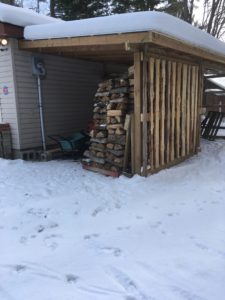
I’m busy creating a workshop in the garage so I can really get going on the nesting. So many fun projects on my list. To reclaim the garage, I’ve had a structure built to house firewood and, when fully finished, to be a tool shed. This will keep firewood and large implements out of the garage so I can start to settle there, too.
I have other things I probably should be doing. But the force to reclaim this space is strong in this one, so to speak. I feel like I can’t start my “next big thing” until I’m done this series of smaller things.
That was me, blowing the dust off this blog. It has been a while.
=====
Confession: I love winter.
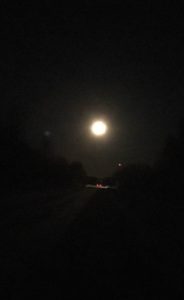
Supermoon over Coby
I love the crispness of the air, the freshness that new snow lends every vista. I love having a vista, of sorts.
I love the challenge: staying warm, balancing system heat with wood heat, the work of shovelling, snow-blowing, stacking, sweeping. God help me, I even like winter driving. That is to say, I’m not put off by it. Bring it on. Â A “supermoon” hung over the east sky a few nights ago, as I was piecing my way through a few squalls to get home. Like a huge bauble, dangling just above the horizon. Â Gorgeous.
I love the coziness of a fire when the temperature is plunging outside, the sound of a hockey game on the tv as I go about other tasks. The happy riot at the birdfeeders when I’ve just re-filled them.
The eagerness on Big Dee’s face when he can see me going through the steps of getting ready to go outside: boots, scarf, coat, hat, go back inside for something (my phone), come back to the door, go back inside again for something else (treats), open the door, close it again, grab my mitts, open the door, close it again, go back inside for something (coffee) … eventually, we get outside. He has learned patience.
Up here, the silence is extraordinary. I’m not really one to judge, given that my world seems to get more silent, or muffled, every day. Maybe silence isn’t really the word – stillness.
This is my second winter up here on my own, and it certainly came on quickly. Â I thought I would have a bit longer to wrap up my outdoor projects … but, no … the shed isn’t finished and the raised beds still stand. Oi.
The plan, for those who are still following along, was not for me to be here on my own. Yet, here I am. It has, in fact, worked out. I want to say something about the journey up here as part of a couple in 2011, the rapid deterioration, the frantic yet dismal attempts at repair, the denouement late summer of 2015. But … what to say? It did NOT work out. Â Anger, hurt, blaming – all the old standards. Â I did not blow the dust off the blog to re-visit the minutia of the hash we both made of it.
The fact of my life at the moment is that each season up here is a gift. I wouldn’t have moved up here, independently. It doesn’t make a ton of logistical or financial sense. I had to be given the context to step back into a non-urban life. The fact that the context evaporated pretty quickly left me with a choice: Â stay by the river or return to the city. Every cell of my being said, unhesitatingly, “stay”. Â So I am grateful for the context, if you will, dragging me up the road and depositing me by the river.
The first four seasons on my own were, quite possibly, the happiest I’ve been for so many years. The absence of tension was palpable. I’d come home from the city and just stand on the landing between the kitchen and the living room, looking out over the deck, and marvel at the opportunity I have to re-invent myself. Re-plant, perhaps. A transplant, happy to find herself in a place that restores and nourishes.
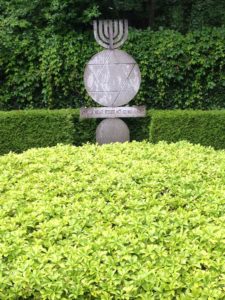
The Dachau Concentration Camp Memorial site is set up to educate with as much clarity and sensitivity as possible while also memorializing the tragic brutality that this ground witnessed. There are multiple sculptures, plaques, monuments, etc. that commemorate the victims and the crimes perpetrated. Newer buildings are on site as memorials, sponsored by multiple faiths that had clergy/leaders/members in the camp, including obviously a Jewish representation but also Catholic, Protestant, and Russian Orthodox. One of the buildings is currently in use as a nunnery.
There is no minimizing, dodging or obfuscating the role of this camp, the first concentration camp, in setting the tone for other camps. Everything that was done elsewhere started here. Given all the things I saw as testament to the crimes and death that occurred … what is really a struggle for me is understanding how vast the network of camps and sub-camps was. We were shown a map of the territories held by Germany at the peak of the war and the map was filled with literally hundreds of locations where versions of this place, in smaller and larger scales, were located. We have heard only of a handful of the usual names – Auschwitz-Birchenau, Treblinka, Bergen-Belsen, Dachau. But there were literally hundreds of camps and sub-camps. I was aghast at the breadth and scope of barbarism undertaken across such a wide geographic area.
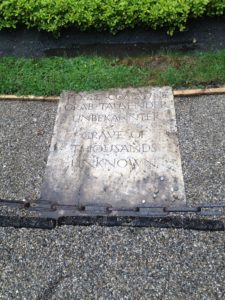
Grave to mark ashes of thousands of unknowns (Jewish Memorial)
During my visit, it was (mostly) quiet. People were respectful and clearly there to learn, to try to comprehend, to absorb. Entrance to the site is free. I’d estimate there were a few thousand people there while I was there, so it is well used. There are lots of trees around the exterior of the camp proper, and thus lots of birds singing. That seemed out of place, as if the birds should know better. It poured rain, on and off, and that seemed entirely in keeping with the mood. Our tour group had 15 high school kids from Indiana and it was interesting to watch them go from being “too cool for this” and sort of detached to being really quite sober. I overheard discussion of the use of this memorial site for school groups and it appears that schools from all over Europe and North America make stops here. That feels like a good thing, but it does make it a bit of a challenge for maintaining the appropriate decorum when pre-teens and teens are responding to what they see with humour or (feigned) apathy. I think Dachau has an impact on everyone who visits and I think it is important for as many young people from as many different backgrounds as possible to see it – and I also think that kids don’t always know what to do with their emotional responses “in the moment”.
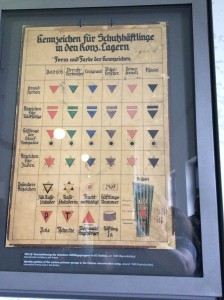
The Original Pink Triangle
It felt oddly synchronous to be looking at the actual original pink triangle symbol, as deployed to identify a homosexual “enemy of the state”, the day after World Pride had wrapped up in my home city of Toronto. There is no more clear reason to justify the existence of an event like “World Pride” than standing in an original building at Dachau and looking an original wall chart of symbols used to identify people, one of which was a pink triangle. Interestingly, there is a committee of survivors that has a crucial role in determining the types of memorials that will be allowed. A memorial focusing on homosexuals is absent because, in the hierarchy / social structure of the camp at the time, homosexuals were at the bottom of the barrel along with known criminals and other “asocials”. The committee of survivors isn’t comfortable acknowledging the targeting of homosexuals by approving a memorial for this group. When I spoke to our guide about this privately, he suggested that people were waiting for the committee of survivors (which is quite small now) to hand over their legacy to perhaps a more current committee with a more current perspective. I would have liked to have seen something there as an acknowledgement that gay people were one of the many groups identified as “enemies of the state” – and I also think this can wait until the time is right. Homosexuals are identified within the part of the exhibit that describes all the targeted groups, and our situation is given as much detail and focus as most of the other groups.
I took only a handful of pictures. It didn’t seem … seemly.
Dachau is just outside of Munich and the typical journey one takes to get there is from the Hauptbahnhof (main train station) in Munich. It is a short 10-15 minute ride. German citizens in Munich are extremely sensitive about people coming to visit to learn more about Nazis and about concentration camps. I knew about specific laws around giving an Nazi salute (even in jest, this will get you arrested) and I didn’t realize Mein Kampf was still a banned book. It was odd to be taking a tour with a group to specific sites relevant to WWII and to be scrutinized by the locals. They will listen and try to be sure the guide isn’t Munich-bashing or sensationalizing. Locals are also concerned with Neo-Nazis using specific sites as touchstones for their own purposes. As much as they don’t want their quite beautiful city associated with the rise of the Nazi party, as it happens, this is now a key part of the city’s past. Never mind that the PLO leveraged this association with the murders during the Olympics in 72, which adds another horrific piece to the global perception of Munich. I don’t want to suggest that Munich has had a bad rap – it is what it is – but it is a pleasant place, rich in layers of history beyond the 20th Century, walkable, reasonably friendly – I quite enjoyed it.
There are lots of very subtle, slightly subversive, commemorative elements in Munich. Many bullet holes and other types of damage have
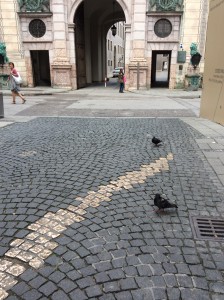
Dodger’s Alley
been left, on purpose, unrepaired, in the architecture, like reminders. Scars. You have to look for these, but they are there. A more deliberate, striking example is a metallic (gold? bronze?) shimmering trail down the cobblestones in an alleyway known as Dodger’s Alley. In the 30’s/40’s, citizens of Munich who walked by a specific Nazi plaque on the corner of one of the main squares had to give a Nazi salute or be arrested for not doing so. There were lots of people who didn’t want to give a Nazi salute. So, to avoid walking by that plaque, many would take a detour down Dodger’s Alley. Nazi authorities caught on to this and started policing the use of the alley, interrogating people found in the alley as to their purpose for being there. If no satisfactory purpose was offered, a person would be thrown immediately into Dachau. Just for taking a detour to avoid giving a salute. Even these people were “enemies of the state”. As to the metallic trail, there is no plaque or explanation. You need to just know, or be told, why it is there and what it signifies. Apparently, there are lots of these sorts of things all over the city, commemorations of resistance. I didn’t have time to go find more, unfortunately.
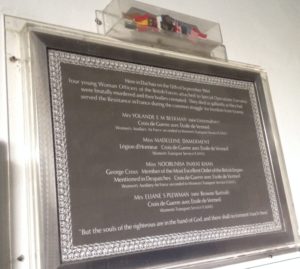
Four Heros You Need to Know About
I will close by noting this plaque. It is almost hidden behind a door that leads from the gas chamber into the crematorium. (Please don’t imagine that I typed that sentence with any degree of casualness.) There is a railing in place, making it harder to get a straight on, close photo. Since it is hard to read, I’ll type out what it says here. They gave their lives – the least I can do is try to get this right.
Here in Dachau on the 12th of September 1944 four young Woman Officers of the British Forces attached to Special Operations Executive were brutally murdered and their bodies cremated. They died as gallantly as they had served the Resistance in France during the common struggle for freedom from tyranny.
Mrs. YOLANDE E M BEEKMAN (nee Unternahrer) Croix de Guerre avec etoile de Vermeil Women’s Auxiliary Air Force seconded to Women’s Transport Service (F.A.N.Y.)
Miss MADELEINE DAMERMENT Legion d’Honneur Croix de Guerre avec etoile de Vermeil Women’s Transport Service (F.A.N.Y.)
Miss NOORUNISA INAYAT KHAN George Cross Member of the Most Excellent Order of the British Empire Mentioned in Dispatches Croix de Guerre avec etoile de Vermeil Women’s Auxiliary Air Force seconded to Women’s Transport Service (F.A.N.Y.)
Mrs ELIANE S PLEWMAN (nee Browne-Bartoli) Croix de Guerre avec etoile de Vermeil Women’s Transport Service (F.A.N.Y.)
“But the souls of the righteous are in the hand of God, and there shall be no torment touch them”
Bravery, compassion and a complete and utter focus on their missions, to the exclusion of all else, including their own lives. This was a surprise find towards the end of my visit to Dachau – but it shouldn’t have been. I feel like I should know these names and that I should know more about these stories. Their world, a world in which their skills and dedication were needed at extreme cost, is not that far removed from our current time of social media, popular culture, ridiculous fads and trivial pursuits.
In Grade 12, I wrote a paper on Scott Joplin for music class. I had to do a great deal of research on it and it is the first topic I remember getting seriously “hooked” on, from a research perspective, other than WWII.
I spent more time on that paper than anything else I did that year. I spent hours reading every book I could get my hands on that was remotely related to music in the US at the turn of the 19th/20th Century. And, of course, I read about Scott Joplin specifically. I have only the vaguest recollection now of the specific details of his story but I have clear and distinct memories of my emotional reaction to the tragedy of his story. The raw, clear expression of talent that would not be suppressed vs. extreme social forces working against that talent. At times, I wept while listening to multiple interpretations of almost every piece he wrote, the popular and the obscure. I disliked the “hot dog” speed demons who turned these gems into blurry races of music. To me, his compositions are not meant to be played even briskly – the subtlety is lost. Played slowly, to me, the pain and knife’s edge place between brilliance and subservience that Joplin lived in for most of his life just cry out. Back in the day, I settled in on Joshua Rifkin as my favourite interpreter for his slower, contemplative tempos and his ability to pull the emotional centre out of the music.
I listened and I wept. I still have that paper somewhere and, to this day, a slow, careful interpretation of Joplin’s best can really get me. The guy wrote all this material, was famous, to a degree, yet died in relative poverty, pain and obscurity with much of his best work unseen and unstaged.
So I’m writing this big, completely unrelated, report for work and there are numbers, charts and graphs spinning around my head most of the day. It has been said that music without lyrics is best for concentration so I’ve turned back to one of my original research subjects, Master Joplin, for background music and, still, some interpretations catch me off guard, right in that soft spot. When that happens, I have to stop writing for a moment and just listen.
Researching that Scott Joplin paper would be so different now. There are so many online resources and oh so many options for listening and comparing versions of specific pieces. YouTube is a treasure trove. There are other Joplin aficionados out there, imagine that, and some have put together amazing playlists of a variety of performers and versions. It is mind boggling. There are different variations of his story out there and debates about what happened, when, to whom. I haven’t had time to read all this – I’ve just been listening as I attempt to piece together decidedly non-musical data, attempting to turn it into useful information.
There are multiple routes to get from The PostCard to my workplace, in the extreme east end of Toronto. On the best driving day, with no construction, traffic volume issues, weather, detours or gas/coffee stops, it is one hour, 50 minutes. This, of course, depends on the route taken and I’ve discovered many “new” routes and, each time, I insist that the route is “shorter”.
Technically, this may be true. The new routes get “shorter” but the time to destination keeps getting longer. The “new” routes zig zag past farm land, rolling hills, small towns, villages, hamlets, french fry trucks, abandoned farm equipment, antique shops … a myriad of distractions. I find the “new” routes so much more interesting, especially during dramatic seasonal changes when the landscape seems to shift before my eyes. Right now, we are changing gears from a coolish summer to a gorgeous fall and the colours, the angle of the light, can be breathtaking.
Of course, I find these views, and the act of driving through them, nostalgic as all heck. When you are raised out in the country and you are also an active young person, involved in lots of extra curricular activities, you spend a lot of time driving places to do the things you are interested in. My Mom drove me everywhere. I remember early morning band practices, with the mist rising off the fields and creeks in the semi-dark. I remember navigating countless snowstorms to get to hockey tournaments. Driving in to the city every other Saturday to visit Grandma. Being dropped off or picked up at the school for newspaper, theatre projects, or some event or other. Driving great distances to get to do something, and then driving home, was part of my “culture”, growing up. As soon as I got my license, I was in charge of driving myself, for the most part. Long drives through the night from the community almost an hour north where I taught guitar one night a week. Driving with my buddies into the city for a movie night from time to time – a huge treat.
As a younger passenger, there might have been a book to read or a crossword puzzle but there were certainly no electronic pacifiers for these drives. There was looking out the window, noticing changes and commenting on them. Riding along was a time to think about things, to sort through whatever pre-teen or teen emotional angst was current. I remember sitting beside my mother, countless times, in my sullen mopey way, rolling my eyes at some bit of wisdom or observation she may have had which was, from my perspective, clearly out of touch with reality and definitely NOT COOL. I remember feeling, as a driver, all grown up when I was able to safely get myself – and often my friends – from activity to activity. That certainly felt cool.
My brothers are both drivers of long distances as well. When my nieces and nephews were in school, 2.5 hours from the community where they were raised, it was nothing for my brother and sister-in-law to drop everything, drive down to them and take them out to dinner or something and drive back. My other brother will drive hours north to “his” jointly owned fishing lodge to do engine maintenance or to fix something. Two of my nieces decided to start a main street, touristy summer business in Grand Bend, a daily one hour one way drive for 12 hour shifts. We, in our family, drive a lot and don’t seem to mind it.
This week has been one of the harder ones to manage, schedule wise, but it has worked out okay. I wound up staying in NewMarket after my Tuesday night hockey game at a funny little motel I discovered at the north end. It is clean, feels safe and inexpensive (I think I’m getting a deal now), and has a free breakfast. So, I can get up very early, hit the road home for the last hour and 15 minutes and be in front of my computer screen by 9 a.m., ready to go. On Wednesday morning, I tried to avoid the mass exodus of people going south on the 404 and took Old Yonge St. north to Mount Albert Road. This took me on a narrow road though some picturesque valleys with the requisite mist softening the sunrise. It was really gorgeous.
I came home last night from a work/social event and arrived in pretty good time, about 10:20 p.m. Driving through the inky dark night, zig-zagging through the rural back roads of Ontario, having time to quietly process all that is current or pressing in my life, listening to an audio book or CBC … it doesn’t feel at all like a burden or waste of time. It feels normal and necessary. I’m glad to have some ability to negotiate the timing of the driving and I am often overcome with gratitude for the generous and welcoming friends who let me stay with them in Toronto on the nights when the drive isn’t negotiable. But the drive itself? Sometimes … to me … it is one of the most magical parts of living out the city.


 memorializing the tragic brutality that this ground witnessed. There are multiple sculptures, plaques, monuments, etc. that commemorate the victims and the crimes perpetrated. Newer buildings are on site as memorials, sponsored by multiple faiths that had clergy/leaders/members in the camp, including obviously a Jewish representation but also Catholic, Protestant, and Russian Orthodox. One of the buildings is currently in use as a nunnery.